- Home
- Roofing services
- Roof replacement
Roof replacement in Luton
Roof replacement in Luton for owners of terraces, semis and bungalows whose slates or tiles are past repairing. We strip the old covering, check the timbers, fit new underlay, battens and fixings to BS 5534, improve the loft insulation where the rules call for it, and make sure the building control paperwork is in place.
Planning a new roof?
Name, number and postcode is enough. We phone back to hear what is happening and set a time to see the roof.
- Building regulations explained
- Loft insulation upgraded
- Scaffold licence planned in
When does repairing stop making sense?
When the faults are everywhere rather than in one place. Slates slipping across both slopes because the nails have rusted through, underlay that crumbles to the touch, soft battens, or a roof patched again and again are all signs the covering has reached the end of its life.
Age alone is not the test; condition is. We look at the roof slope by slope, inside and out, and tell you plainly whether repair or replacement is the better spend, with photographs so you can judge for yourself. If you are not sure yet, a roof inspection is the place to start, and our roof repairs page covers the smaller fixes.
What goes into a new pitched roof?
New underlay, battens and fixings under a covering fixed to the current standard, BS 5534:2014+A2:2018. LABC Warranty sums up the main change: "All single lapped tiles on a roof now need to be mechanically fixed", and ridge and hip tiles too. Marley adds that tiles round the edges need double fixing. The underlay goes on "with a maximum 15mm drape" between rafters.
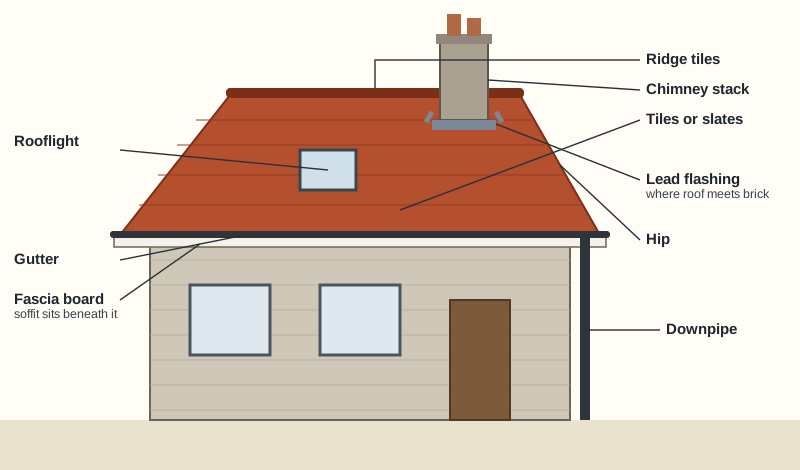
The drawing labels the parts of a typical pitched roof. On a re-roof we strip back to the rafters, so any timber that has rotted or split can be dealt with before anything new goes on.
Does a new roof need building regulations approval?
In most cases, yes. For re-roofing, Planning Portal says: "In most situations, this work will need Building Regulations approval." GOV.UK lists replacing roof coverings as work you must tell a building control body about unless a roofer registered with a competent person scheme does it; otherwise you "will have to submit a building notice or full plans application and pay a fee".
The competent person schemes for roof coverings are CompetentRoofer, run by the National Federation of Roofing Contractors, and NAPIT. A member can self-certify instead of applying for approval, and should give you a certificate of compliance; GOV.UK says to contact the scheme operator if it has not arrived within 30 days of completion. Work that does not comply can lead to prosecution and unlimited fines. Whoever you hire, ask before work starts which route they will use and keep the certificate, because you may be asked for it when you sell. Our written quote sets out how your roof will be signed off.
Will the loft insulation need upgrading?
Usually, yes. Planning Portal says re-covering a roof "should also include for improving the thermal insulation". Under Approved Document L, renovating more than half of a roof means upgrading the whole of it, to a U-value of 0.16 W/m²K where that pays back within 15 years. On a pitched roof with a cold loft, that often means topping up the insulation at ceiling level; Milton Keynes Council's re-roofing guide, for example, says "270mm of mineral wool at ceiling level is adequate".
A better-insulated loft is a colder one, so ventilation matters more. We make sure air can still flow in at the eaves and out higher up, so condensation does not form on the new timbers.
Can the roof take a different, heavier covering?
Not without checking. Swapping slate for concrete tiles, or the other way round, changes the load on the timbers. Planning Portal says changing the covering material is likely to need approval, that a heavier covering means the structure "may need modifying and/or strengthening", and advises getting a structural engineer or surveyor to check first.
The threshold is set down. Approved Document A treats an increase in roof loading of more than 15% as significant, and Planning Portal says a covering that adds 15 per cent or more to the weight needs approval. Going lighter is not automatically safe either: Approved Document A says a roof that loses a lot of dead load should be checked against wind uplift.
Terraces lean on one another, which is why work on one house is never quite separate from its neighbours. In 1959 the council judged 100 High Town Road unfit to live in, yet Bedfordshire Archives records that demolition was rejected because it "would adversely affect the stability of the neighbouring properties".
Do you need planning permission or listed building consent?
Not usually for a like-for-like re-roof. Planning Portal says roof work that "does not materially affect its external appearance" normally needs no planning permission. A council can remove that freedom with an Article 4 direction, so check whether one applies to your street.
Listed buildings are stricter. Historic England says consent is needed for work that alters a listed building's special character, and under section 9 of the 1990 Act doing such work without consent is an offence, with up to two years' imprisonment on indictment. If your house is listed or in a conservation area, speak to the council's conservation team before materials are ordered. Our guide on permission for a new roof goes into each case.
What happens if bats live in the roof?
The work is planned around them. Historic England says "Almost all UK bat species have been found roosting in roofs", and GOV.UK lists roof work among the activities that can affect them. Roosts are protected, and harming one can mean prison or an unlimited fine, so where there are signs of bats a survey comes first and, if harm cannot be avoided, a licence from Natural England.
Bats affect the materials as well. Historic England notes that bats "can become entangled" in breathable roofing membranes, and that hessian-reinforced Type 1F bitumen felt is the bat-friendly choice. Natural England says buildings with "uneven roof tiles and large roof timbers" are likely roosts, which describes plenty of older houses.
Will the scaffolding need a licence from Luton Borough Council?
Only if it stands on the pavement or road. GOV.UK says "You need a licence from the local authority to put up scaffolding or hoarding on a public highway". Luton Borough Council's licence costs £205 and lasts up to 28 days, with a £550 deposit that is refunded afterwards. The council wants at least 10 working days to process an application and public liability cover of at least £10 million from the applicant, and issues licences under the Highways Act 1980. We build that notice period into the start date.
A full re-roof needs scaffolding: HSE says "sloping roofs require scaffolding to prevent people or materials falling", and on terraces the edge protection goes at the back as well as the front. The scaffold should be inspected before first use, then "every 7 days" and after bad weather.
What does a new roof cost?
A great deal more than a repair, which is why we only recommend one when repairs no longer make sense. Which?, on 22 October 2026, gave £7,000 to £21,000 for a new tiled roof on an average three-bedroom house, excluding VAT. Checkatrade, updated June 2025, gives an average of £7,000 within a range of £4,000 to £19,000. These are national figures, not ours. We price your roof from measurements and give a written quote that lists the covering, underlay, insulation and scaffold, as with every job for homeowners around Luton.
Questions people ask us
Do I need planning permission to replace my roof?
Not usually, if the new roof looks the same as the old one. Listed buildings, and streets where an Article 4 direction covers roofs, are the exceptions.
What certificate should I get after a new roof?
A certificate of compliance. GOV.UK says to chase the scheme operator if it has not arrived within 30 days of completion, and you may be asked for it when you sell.
Can I swap my slates for concrete tiles?
Possibly, but it changes the weight on the roof, so approval is likely and a structural check should come first.
How long does a Luton scaffold licence take?
Luton Borough Council says it needs at least 10 working days to process an application for scaffolding on the highway.
Sources and further reading
- BS 5534:2014+A2:2018 Slating and tiling for pitched roofs and vertical cladding, BSI Knowledge, pub. 28 Feb 2018
- Tech update: roof tiling and underlays, the new BS 5534 standards, LABC Warranty blog
- Changes to the British Standard for Slating and Tiling BS 5534, Marley, undated
- What changes have there been to BS 5534 since the revision in 2014?, Marley, undated
- Building regulations: Re-roofing, Planning Portal, undated (© 2026)
- Building work, replacements and repairs to your home, GOV.UK (shows "Updated 3 November 2014"; metadata 2026)
- Competent person scheme: current schemes and how schemes are authorised, updated 17 Sep 2026
- Approved Document L Vol 1: Dwellings, 2021 edition incorporating 2023 amendments
- Re-roofing Guide (M10979), MK Building Control, undated
- Approved Document A: Structure, 2004 edition incorporating 2004, 2010 and 2013 amendments
- Building Regulations: Work to an existing roof, Planning Portal, undated (© 2026)
- 100 High Town Road, Luton
- Roof (planning permission / permitted development), Planning Portal, undated (© 2026)
- Permitted development rights for householders: technical guidance (shows "Updated 10 September 2019")
- What Permission Might I Need to Make Changes to My Older Home?, Historic England, undated
- Planning (Listed Buildings and Conservation Areas) Act 1990, s.9 Offences
- Works to Roofs, Walls and Building Services (Building works and bats), undated
- Bats: protection, surveys and licences (shows 29 Mar 2015)
- Bats: advice for making planning decisions, updated 7 Apr 2025
- Scaffolding and hoarding licence (England and Wales), GOV.UK, 19 Jul 2023
- Apply for a scaffolding or hoarding licence, Luton BC, undated (forms Dec 2025/Feb 2026)
- Roof work (construction safety topics), HSE, 5 Jun 2026
- Construction: Work at height FAQs, HSE, 11 Mar 2026
- How much do roof repairs cost?, Which? (N. Turner, V. Purcell), 22 Oct 2026
- Roof replacement: Cost breakdown 2025, Checkatrade, updated 30 Jun 2025
Before you phone
These details help us understand the roof before we see it:
- Where the water shows, and in what weather
- Slate, tile, flat roof or not sure
- Roughly when the house was built
- Any photos, even from the street
- Conservation area or listed, if you know
Roof replacement in the towns around Luton
We carry out roof replacement in Luton and across the towns below. Each town page explains what is different about the roofs there.
Roof replacement in Dunstable
Roof replacement in Houghton Regis
Roof replacement in Leighton Buzzard
Roof replacement in Ampthill
Roof replacement in Hitchin
Roof replacement in Letchworth Garden City
Roof replacement in Stevenage
Roof replacement in Harpenden
Roof replacement in St Albans
Roof replacement in Welwyn Garden City
Roof replacement in Hemel Hempstead
Roof replacement in Berkhamsted
Roof replacement in Tring
Guides that go with this
Do I need planning permission or building regulations for a new roof?
When a new roof needs building regulations approval, planning permission or listed building consent, and the extra estate consents in Letchworth and Welwyn Garden City.
Roof repair cost in 2026: what do UK price guides say?
National price ranges for repairs, new roofs, gutters, fascias and chimneys, each with its publisher and date, and what pushes a quote up.
What causes slipped roof tiles, and how should ridges be fixed?
Why tiles and slates slip, what the British Standard now says about fixings, and how mortar and dry ridge systems compare.
Related work
Flat roofing
Garages, dormers and rear extensions re-covered in EPDM, GRP or built-up felt, laid to proper falls and insulated where the rules require it.
Roof inspections
A look at the roof from outside and the loft, with photographs and a written note of what needs doing now and what can wait.
Everything else we do
Roof repairs
Slipped slates, cracked tiles, loose ridges and drips through the ceiling, traced to where the water really gets in and put right.
Emergency and storm repairs
After high wind or a downpour, we make the roof safe and weathertight with temporary covers, then photograph everything for your insurer.
Chimney repairs and leadwork
Damp chimney breast or a stain round the stack? We check the flashings, flaunching and pointing, then repair or renew the lead properly.
Gutters, fascias and soffits
Overflowing gutters, rotten fascia boards and tired soffits renewed with care for loft ventilation, nesting birds, bats and older asbestos boards.
Tell us about the roof
Give us your name, phone number and postcode, pick the closest match to the problem, and we will ring to discuss it and fix a time to inspect. Or call 01582 377176.