- Home
- Roofing guides
- Flat roof types
Sources checked 12 November 2026
EPDM, GRP or felt: which flat roof should you choose?
Choosing between EPDM roofing, a GRP flat roof and a felt flat roof is the main decision when a garage, dormer or extension roof in Luton needs replacing. This guide compares the three using manufacturers' certified figures and the current British Standard, so homeowners and landlords can pick the one that suits their roof.
Get the roof looked at
Name, number and postcode is enough. We phone back to hear what is happening and set a time to see the roof.
What is the difference between EPDM, GRP and felt?
All three are waterproof layers laid over a flat deck; they differ in what the layer is made of and how it goes down.
- EPDM is a synthetic rubber membrane, usually laid as one large sheet bonded to the deck, so a small roof can have few or no joints.
- GRP (glass-reinforced plastic, often called fibreglass) is built up on the roof from glass-fibre matting set in resin, then finished with a coloured topcoat.
- Felt, more properly reinforced bitumen membrane, goes down in two or three layers with a mineral-faced cap sheet on top.
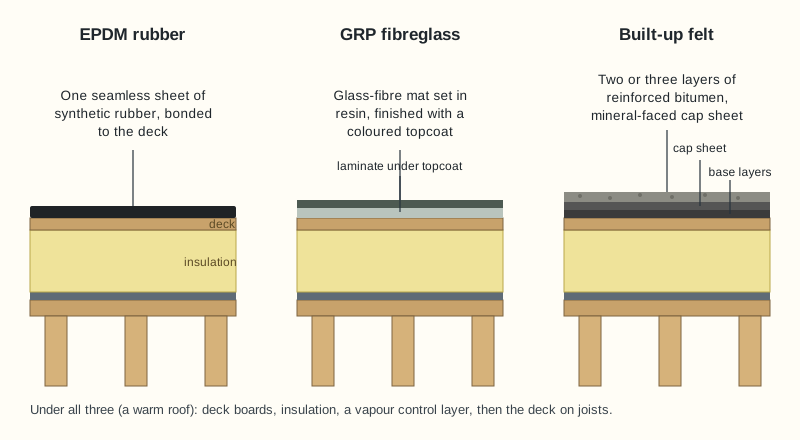
In a modern warm-roof build each sits on the same insulated deck, so the choice of waterproofing does not change what is underneath. What it changes is how joints, edges and upstands are formed, how the surface takes foot traffic, and how it copes with a complicated shape.
How long does a flat roof last?
Stated service lives run from more than 15 years to at least 35, and they depend on the product as much as the material. Most come from BBA certificates; the Cure It figure is the working life assumed in its European Technical Assessment, and the IKO figure is from IKO's own NBS Source listing:
| Product (type) | Certificate | Stated life |
|---|---|---|
| ClassicBond Non-reinforced (EPDM) | BBA 22/6065 | "will have a service life of at least 35 years" |
| ClassicBond PRO Fleece Reinforced (EPDM) | BBA 22/6065 | "service life of at least 35 years" |
| Firestone RubberCover (EPDM) | BBA 89/2216 | "a life of at least 30 years" |
| Topseal (GRP) | BBA 93/2932 | "durability in excess of 15 years" |
| Cure It kit (GRP) | ETA 20/0908 | working life "25 Years" |
| IKO Ultra Prevent (reinforced bitumen) | NBS Source listing (BBA 91/2671) | "a life expectancy in excess of 25 years" |
Read the small print as well as the headline. The Topseal certificate adds that a well-formed GRP laminate "can maintain its integrity for 30 years". The LRWA, which lists the Cure It figure, notes that a working life is not a guarantee and that it does not test products itself. IKO's separate 25-year guarantee applies only when one of its approved contractors lays the system.
All of those lives assume the roof is designed and laid properly. A good membrane on a deck that holds water will not reach them, which is why falls matter as much as the material.
Why do falls matter on a flat roof?
Because water has to run off rather than sit. The current standard, BS 6229:2025, sets a minimum 1:80 finished fall for general roof areas and internal gutters, according to the NFRC's summary of 18 December 2025. It also calls for a level survey and a documented handover for decks and slabs.
Decks deflect and timbers are never perfectly true, so designers aim steeper than the finished minimum. The BBA certificate for ClassicBond PRO tells them to design for twice the minimum finished fall, which for a 1:80 finish works out at 1:40 at design stage.
Standing water a day or two after rain is the visible sign that a fall is not working. When we look at a failing flat roof, we note where water stands and check whether the deck can be re-laid to a proper fall before any new covering is discussed.
Which flat roof covering should I choose?
No single covering wins on every roof; shape, use and budget decide it.
- EPDM carries the longest certified lives in the table above, and on a plain rectangle it goes down with very few joints. Every pipe, rooflight and corner needs its own formed piece or flashing, so busy roofs take more care.
- GRP gives a hard, jointless finish that suits occasional foot traffic and awkward shapes, because it is laid as a liquid and cures in place. It needs dry weather to cure and a stiff, sound deck beneath it.
- Felt is the cheapest of the three per square metre in Checkatrade's February 2026 cost guide, and modern multi-layer systems such as the IKO product above are listed with a life expectancy of more than 25 years.
Published prices for each are in our roof repair cost guide, and our flat roof page covers repair as well as replacement.
Do I need building regulations to replace a flat roof?
Usually, yes. GOV.UK lists replacement of roof coverings on pitched and flat roofs as work you must tell a building control body about, unless a roofer registered with a competent person scheme does it and issues a certificate of compliance.
Insulation comes with it. Approved Document L treats replacing the waterproof membrane on a flat roof as renovating a thermal element. If more than half of the roof is renovated, the whole roof should reach an improved U-value of 0.16 W/m²K, unless that would not pay back within 15 years or is not technically feasible, in which case the best level that does pay back applies. Planning Portal puts it plainly: when a flat roof with integral insulation is replaced, you may be required to upgrade it.
Thicker insulation raises the finished roof level, which affects upstands, door thresholds and edge trims, so it should be planned before work starts rather than found out halfway through.
Does fire rating matter for a flat roof near a boundary?
It can, for extensions and garages close to the boundary. Trade guidance from the LRWA, NFRC and SPRA (March 2024) says a flat roof system classified BROOF(t4) can be used without restriction on distance from the boundary, while a CROOF(t4) system needs to be at least 6m away.
The classification applies to the whole system as installed, not just the top layer, so check that the certificate covers the deck and insulation actually being used. Rear extensions on terraced and semi-detached houses are often close to next door, so it is a fair question to ask any roofer.
Where do flat roofs usually leak?
Check the edges and junctions first: the upstand where the roof meets the house wall, outlets and gutters, rooflight kerbs, and any split or blister where water has stood.
Where lead covers the upstand, the Lead Sheet Training Academy advises lengths of no more than 1m where lead is bonded to felt, asphalt or single-ply, against 1.5m elsewhere. Overlong pieces at that junction are worth looking for.
Water can also travel under a membrane before it shows inside, so the drip is not always below the fault. Our guide to a roof leaking in heavy rain explains how to trace it, and our Luton roofers can check the whole roof before you decide between repair and replacement.
Questions people ask us
Is EPDM better than GRP?
Neither is better on every roof. The EPDM certificates quoted here give at least 30 to 35 years, while the GRP figures are more than 15 years for Topseal and an assumed working life of 25 years for Cure It, but GRP suits awkward shapes and foot traffic, so the roof itself should decide.
How long does a felt flat roof last?
It depends on the system. IKO's Ultra Prevent reinforced bitumen membrane is listed on NBS Source with a life expectancy in excess of 25 years, assuming it is laid to proper falls.
Does a new flat roof need more insulation?
Usually, yes. Approved Document L treats replacing a flat roof's waterproof membrane as renovation, so if more than half the roof is done the whole roof should normally reach 0.16 W/m²K where that pays back within 15 years.
Sources and further reading
- ClassicBond Non-reinforced EPDM, BBA Certificate 22/6065, first issued 27 Oct 2022
- ClassicBond PRO Fleece Reinforced EPDM, BBA Certificate 22/6065, first issued 27 Oct 2022
- Firestone RubberCover EPDM System, BBA Certificate 89/2216, 2nd issue 27 Nov 2018
- Topseal Roof Waterproofing System (GRP), BBA Certificate 93/2932, first issued 24 Sep 2009
- Cure It Composites (product register entry; ETA 20/0908), LRWA
- IKO Ultra Prevent roofing systems, NBS Source (BBA 91/2671)
- BS 6229:2025 update: key points for members, NFRC, 18 Dec 2025
- Flat roof replacement costs in 2026, Checkatrade, updated 02/26
- Building work, replacements and repairs to your home, GOV.UK (shows "Updated 3 November 2014"; metadata 2026)
- Approved Document L Vol 1: Dwellings, 2021 edition incorporating 2023 amendments
- Building regulations: Re-roofing, Planning Portal, undated (© 2026)
- Changes in fire regulations for flat roofs (guidance V3), Mar 2024
- The top ten dos and don'ts of rolled lead sheet, RIBAJ, updated 4 Nov 2025
Before you phone
These details help us understand the roof before we see it:
- Where the water shows, and in what weather
- Slate, tile, flat roof or not sure
- Roughly when the house was built
- Any photos, even from the street
- Conservation area or listed, if you know
Written by Luton Roofworks, roofers in Luton covering south Bedfordshire and west Hertfordshire. If your roof needs looking at, use the form or call 01582 377176.
Related roofing work
Flat roofing
Garages, dormers and rear extensions re-covered in EPDM, GRP or built-up felt, laid to proper falls and insulated where the rules require it.
Roof repairs
Slipped slates, cracked tiles, loose ridges and drips through the ceiling, traced to where the water really gets in and put right.
More roofing guides
Roof repair cost in 2026: what do UK price guides say?
National price ranges for repairs, new roofs, gutters, fascias and chimneys, each with its publisher and date, and what pushes a quote up.
Why is my roof leaking in heavy rain?
Where rain gets into a roof, why the stain inside moves, how condensation fools people, and what to do before a roofer arrives.
What causes slipped roof tiles, and how should ridges be fixed?
Why tiles and slates slip, what the British Standard now says about fixings, and how mortar and dry ridge systems compare.
What causes a chimney leak, and how is lead flashing repaired?
The usual causes of a chimney leak, what good leadwork looks like, and the party wall and planning points before removing a stack.
Do I need planning permission or building regulations for a new roof?
When a new roof needs building regulations approval, planning permission or listed building consent, and the extra estate consents in Letchworth and Welwyn Garden City.
Storm damage to your roof: what will insurance cover?
What insurers count as a storm, the evidence they want, how to make a roof safe without risking a claim, and storm-chasing traders.
Roof moss removal: is it needed, and how should it be done?
Whether moss actually harms tiles, what it does to gutters, why jet washing is advised against and how roof coatings can affect guarantees.
Tell us about the roof
Give us your name, phone number and postcode, pick the closest match to the problem, and we will ring to discuss it and fix a time to inspect. Or call 01582 377176.