- Home
- Roofing services
- Roof repairs
Roof repairs in Luton
Roof repairs in Luton for homeowners and landlords with a drip, a ceiling stain or a slate lying on the lawn. We find the point where water is getting in, repair that properly and show you photographs of the fault and the fix, so you pay to cure the cause rather than the symptom.
Tell us about the leak
Name, number and postcode is enough. We phone back to hear what is happening and set a time to see the roof.
- Leaks traced, not guessed at
- Ridges fixed, not just mortared
- Slate matched to your roof
Where is the water actually getting in?
Usually somewhere uphill of the stain, not directly above it. Rain that gets past a slate or tile runs down the underlay or along a rafter before it drips, so a damp patch near a bedroom window can start at the ridge, the chimney or a valley a metre or more away.
That is why we start in the loft as well as outside. With a torch we follow the tide marks on timbers and underlay back to their highest point, then match that to what we can see on the roof. We photograph both ends of the trail, so you can see why we are repairing the spot we are repairing.
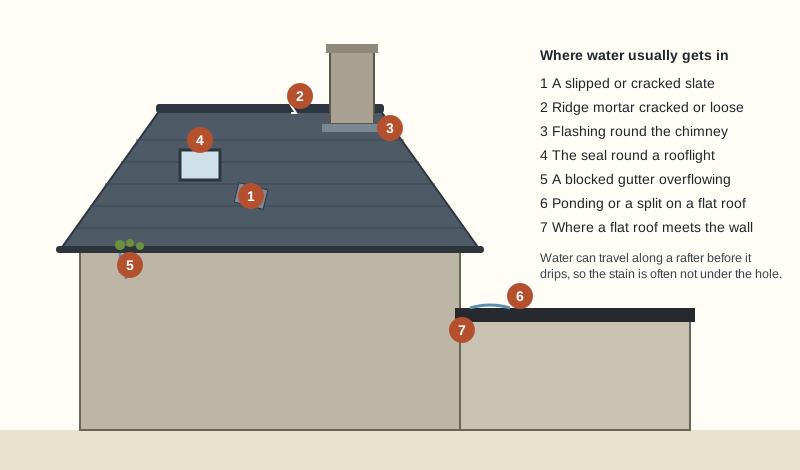
The drawing shows seven places rain commonly gets in. A leak can come from two of them at once, which is why one patched slate sometimes seems not to work: the second entry point was never found. If yours only shows in a downpour, our guide to a roof leaking in heavy rain goes through the likely causes.
Can a slipped or cracked slate just be replaced?
Yes, in most cases one slate can be replaced without disturbing its neighbours. The nails of the broken slate are cut with a slate ripper, a new one of the same size and thickness slides into place, and a strip of lead or copper turned up under its bottom edge holds it, because the nail holes are hidden beneath the course above.
Tiles are different. Most hang on battens by nibs along their top edge, and the standard now expects more than that. Guidance from Specification Online and Marley in 2016 put it plainly: "every single lap tile will have to be mechanically fixed". When we replace tiles we nail or clip them, rather than trusting the nibs alone.
The current version, BS 5534:2014+A2:2018, covers "normal re-roofing work, including repairs" as well as new roofs. On an older or listed house there is a caution: Marley notes that the standard's recommendations "may not always be appropriate for old roofs", so we agree the method with you, and with the council where needed, before we start.
Why do ridge tiles keep coming loose?
Because most older ridges and hips were held on by mortar and nothing else. Mortar cracks as the roof moves through hot and cold seasons, and once the bedding lets go, the next strong gust can lift a ridge tile clean off.
The rules changed in 2014. Since BS 5534:2014, "mortar alone is no longer deemed sufficient on its own to secure tiles", and ridges, hips and verges need mechanical fixing. LABC Warranty says simply: "All ridge and hip tiles must be mechanically fixed."
There are two ways to do that. One is to re-bed the ridge in mortar and add screws or clips into the ridge timber, so the mortar keeps the weather out and the fixing holds the tile. The other is a dry ridge with no mortar at all; the 2018 amendment brought in BS 8612 for dry-fix ridge, hip and verge systems. A slate terrace usually looks right with mortar, and a modern concrete-tiled roof often suits a dry system. We show you both and you choose. Our guide to slipped tiles and ridges covers the detail.
Will a new slate match the rest of a Luton terrace?
It can, if the replacement is chosen with care. Many of the town's Victorian houses were roofed in natural slate: the c.1860 houses at 21 and 23 Park Street West have "Welsh slate roofs", and Historic England records that 37 to 39 Guildford Street has "a slate roof". Slate reached the suburbs too. In 1913 the writer Edward Thomas dismissed the new houses at Limbury and Leagrave as "brand-new, jerry-built, slated cages".
Natural slate varies in size, thickness and colour from quarry to quarry. We match size and thickness first, because a thick slate will not lie flat among thin ones, and then colour as closely as we can, using sound reclaimed slate where a new one would stand out.
Repairs in the same material rarely need planning permission: Planning Portal says roof work that "does not materially affect its external appearance" usually needs none. A listed house is the exception, since Historic England says consent is needed for work that affects its special character.
Could the valley or the leadwork be the problem?
Yes, and both are hard to judge from the ground. A valley is the channel where two slopes meet, and on many older roofs it is lined with lead. Leaves and moss collect in it, water backs up under the slates at the sides, and the lead can split where it was laid in lengths that were too long.
Lead has clear rules. The Lead Sheet Training Academy says rolled lead should be made to BS EN 12588, warns that "we see the wrong codes of lead used", and says a breathable membrane "should never be used as a underlay for lead sheet". LABC gives "a minimum code 4 lead (depending on location)" for flashings, in pieces no longer than 1.5m. Where a valley or flashing is at fault, we renew the lead to those rules rather than smearing it with sealant. Leadwork round a stack has its own page: chimney repairs and leadwork.
Is a repair enough, or does the roof need more?
A repair is enough when the fault is local and the rest of the roof is sound. If slates are slipping across both slopes, the underlay has perished or the battens are soft, patching one spot only moves the leak along, and we will tell you so.
The size of the job also decides the paperwork. Planning Portal says repairs usually need no building control application when they affect "Less than 50 per cent of the roof" and less than 25 per cent of the building's whole envelope. Going past those limits, altering the structure, or fitting a covering that "increases the weight of the roof covering by 15 per cent or more" brings approval back in. Larger work is covered on our roof replacement page.
What do roof repairs cost?
It depends on access and on what turns up once the roof is opened, so we give you a written price after we have looked, the same way we price every job for homes across Luton. National guides give a sense of scale, but they are not our prices.
Which?, on 22 October 2026, published figures from 11 of its Trusted Traders surveyed in November 2025, excluding VAT: £75 to £400 to replace one to six standard tiles, and £80 to £300 for a single ridge tile. MyBuilder's undated cost guide says minor repairs "typically cost £100 - £300". Which? adds that scaffolding "can significantly increase the cost". Our guide to what roof repairs cost goes through the figures.
How is the work done safely?
By choosing access to suit the job. HSE says ladders are not banned and suit "low-risk, short duration work", with short duration "measured in minutes rather than hours". Swapping one slate near the eaves can be done from a secured ladder and roof ladder. Longer work, or anything up at the ridge of a tall house, needs a scaffold or tower, because HSE also says "almost one in five deaths in construction work involve roof work". We tell you which we need before a price is agreed.
What if someone knocks to say your tiles are loose?
Thank them and close the door. Which? advises "never to deal with a roofer who knocks on your door", and Central Bedfordshire Trading Standards names "repairing loose roof tiles" among the typical offers rogue traders make. The same Trading Standards page says to get at least three written quotes and never to pay the whole amount in cash up front. If you think a tile really has moved, ask a roofer you contacted yourself to look.
Questions people ask us
Can a roof be repaired while it is raining?
Not safely from the roof itself, as HSE guidance says not to go on roofs in rain, ice, frost or strong wind. We can catch water in the loft and fit a temporary cover once the weather eases, then make the proper repair in the dry.
Do I need building regulations approval for a roof repair?
Usually not. Planning Portal says repairs affecting less than half the roof and less than a quarter of the building envelope normally need no application, unless the structure is altered or the covering becomes 15 per cent or more heavier.
Can loose ridge tiles just be re-mortared?
Not on their own any more. Since BS 5534:2014 mortar alone is not treated as enough to hold ridges and hips, so we add a mechanical fixing or fit a dry ridge system.
Will I see what was wrong?
Yes. We photograph the fault before we touch it and the repair once it is done, and send you both with the invoice.
Sources and further reading
- More stringent roof fixing requirements now in force, 23 Mar 2016
- BS 5534:2014+A2:2018 Slating and tiling for pitched roofs and vertical cladding, BSI Knowledge, pub. 28 Feb 2018
- What changes have there been to BS 5534 since the revision in 2014?, Marley, undated
- Tech update: roof tiling and underlays, the new BS 5534 standards, LABC Warranty blog
- Changes to the British Standard for Slating and Tiling BS 5534, Marley, undated
- 21 and 23 Park Street West, Luton
- Plaiters' Lea Conservation Area, Luton: Historic Area Assessment, Research Report 69-2011
- Luton Motor Town (education resource), undated
- Roof (planning permission / permitted development), Planning Portal, undated (© 2026)
- What Permission Might I Need to Make Changes to My Older Home?, Historic England, undated
- The top ten dos and don'ts of rolled lead sheet, RIBAJ, updated 4 Nov 2025
- How to get it right: Too much abutment flashing?, LABC, 25 Aug 2016
- Building Regulations: Work to an existing roof, Planning Portal, undated (© 2026)
- How much do roof repairs cost?, Which? (N. Turner, V. Purcell), 22 Oct 2026
- Roof repair cost guide, MyBuilder, undated
- Construction: Work at height FAQs, HSE, 11 Mar 2026
- Roof work (construction safety topics), HSE, 5 Jun 2026
- How to find a reputable trader, Which? (Tom Morgan), 9 Jul 2026
- Rogue traders, Central Bedfordshire Trading Standards, undated
Before you phone
These details help us understand the roof before we see it:
- Where the water shows, and in what weather
- Slate, tile, flat roof or not sure
- Roughly when the house was built
- Any photos, even from the street
- Conservation area or listed, if you know
Roof repairs in the towns around Luton
We carry out roof repairs in Luton and across the towns below. Each town page explains what is different about the roofs there.
Roof repairs in Dunstable
Roof repairs in Houghton Regis
Roof repairs in Leighton Buzzard
Roof repairs in Ampthill
Roof repairs in Hitchin
Roof repairs in Letchworth Garden City
Roof repairs in Stevenage
Roof repairs in Harpenden
Roof repairs in St Albans
Roof repairs in Welwyn Garden City
Roof repairs in Hemel Hempstead
Roof repairs in Berkhamsted
Roof repairs in Tring
Guides that go with this
What causes slipped roof tiles, and how should ridges be fixed?
Why tiles and slates slip, what the British Standard now says about fixings, and how mortar and dry ridge systems compare.
Why is my roof leaking in heavy rain?
Where rain gets into a roof, why the stain inside moves, how condensation fools people, and what to do before a roofer arrives.
Roof repair cost in 2026: what do UK price guides say?
National price ranges for repairs, new roofs, gutters, fascias and chimneys, each with its publisher and date, and what pushes a quote up.
Related work
Emergency and storm repairs
After high wind or a downpour, we make the roof safe and weathertight with temporary covers, then photograph everything for your insurer.
Chimney repairs and leadwork
Damp chimney breast or a stain round the stack? We check the flashings, flaunching and pointing, then repair or renew the lead properly.
Gutters, fascias and soffits
Overflowing gutters, rotten fascia boards and tired soffits renewed with care for loft ventilation, nesting birds, bats and older asbestos boards.
Everything else we do
Flat roofing
Garages, dormers and rear extensions re-covered in EPDM, GRP or built-up felt, laid to proper falls and insulated where the rules require it.
Roof replacement
When patching no longer makes sense, we strip and re-cover the pitched roof with new underlay, battens and fixings, and explain the approvals it needs.
Roof inspections
A look at the roof from outside and the loft, with photographs and a written note of what needs doing now and what can wait.
Tell us about the roof
Give us your name, phone number and postcode, pick the closest match to the problem, and we will ring to discuss it and fix a time to inspect. Or call 01582 377176.