- Home
- Roofing guides
- Chimney leaks
Sources checked 12 November 2026
What causes a chimney leak, and how is lead flashing repaired?
A chimney leak shows as damp on the chimney breast, a stain beside it or water in the loft after rain. This guide, for homeowners in Luton and the surrounding towns, explains the usual causes, what proper lead flashing repair involves and what to check before taking down a stack you no longer use.
Get the roof looked at
Name, number and postcode is enough. We phone back to hear what is happening and set a time to see the roof.
What usually causes a chimney leak?
Defective flashing where the stack meets the roof is the most likely cause, according to Homebuilding & Renovating. The same 2020 article points to cracked flaunching round the pots, and to older stacks built without a damp-proof course, where water soaking into the top of the stack can work its way down.
Checkatrade gives much the same list: damaged flashing, cracked flaunching, cracked brickwork, worn pointing and a missing cap. Wind adds its own damage; the Institution of Structural Engineers names dislodged chimneys among the typical effects of a storm.
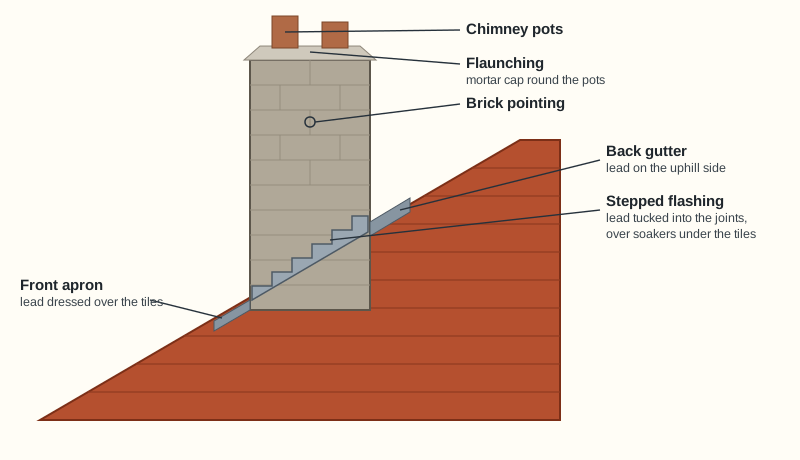
How should chimney lead flashing be made?
From lead of the right thickness, cut into short lengths and set into the brickwork. A chimney normally has a back gutter on the uphill side, stepped flashings down each side and a front apron on the downhill side, each dressed over the tiles and tucked into the mortar joints.
LABC, citing the Lead Sheet Association, says flashings need a minimum of code 4 lead, depending on location, in lengths of no more than 1.5m. The Lead Sheet Training Academy, which replaced the Association in 2018, also advises 1.5m lengths, cut to 1m where lead is bonded to felt, asphalt or single-ply. It warns that breather membrane should never be used as an underlay for lead sheet, and says it sees the wrong codes of lead being used.
The faults to look for are long single pieces that have split, flashings that have pulled out of their joints, and lead that was too thin from the start. Patching these with sealant or tape does not last; re-forming the lead does.
Is a mortar fillet as good as lead?
No. Homebuilding & Renovating calls mortar fillets a cheap, short-life alternative to lead. A fillet is a wedge of sand and cement run along the joint between stack and roof, and once it cracks away from the brickwork it channels water straight into that joint.
On older cottages and terraces a fillet may be original, and in a conservation area there can be good reason to keep a traditional look. Where one keeps failing, properly detailed lead is the lasting fix. We photograph the stack from a safe position, explain which you have and say what we would do.
What is flaunching, and why does it matter?
Flaunching is the sloped mortar cap round the base of the chimney pots, and it matters because it is the stack's own roof. When it cracks, rain gets into the top of the brickwork; Homebuilding & Renovating links this to damp in older stacks with no damp-proof course.
Pointing is the other half. The mortar joints on a chimney are more exposed than any other brickwork on the house, and once they open, wind-driven rain soaks in. Checkatrade's April 2026 cost guide puts chimney repointing at £300 to £1,000, flashing at £250 to £1,000, and most chimney repairs between £180 and £1,000. More national figures are in our roof repair cost guide.
Does chimney work need scaffolding?
In most cases, yes. Flashing, repointing and flaunching take hours, not minutes, and the Health and Safety Executive says sloping roofs require scaffolding to prevent people or materials falling. It allows ladders only for low-risk, short duration work, measured in minutes rather than hours.
A chimney scaffold usually has to reach the stack itself, not just the eaves, which adds to the hire. Homebuilding & Renovating gave scaffolding from about £450 per elevation on a minimum four-week hire in June 2020. Where the scaffold stands on a pavement in Luton, Luton Borough Council charges £205 for a licence lasting up to 28 days, plus a refundable £550 deposit, and says it needs at least 10 working days to process an application, so planned chimney work needs booking ahead.
What should I do with a chimney I no longer use?
Either keep it weathertight and ventilated, or take it down with the right consents. Homebuilding & Renovating advises that redundant flues should be capped and ventilated, which keeps rain out while letting air through to dry the flue.
Removal is a bigger decision. Taking out a chimney breast and supporting the brickwork above on a steel beam will require building regulations consent, according to the same source. In a conservation area the stack may be part of what the council wants to keep: Central Bedfordshire Council calls the removal of a redundant chimney potentially "extremely disruptive" to an area's character, and Stevenage's Old Town management plan says chimney stacks there should be retained and repaired. Adding one needs care too, because on such land GOV.UK says a chimney or flue on a roof slope fronting a highway needs planning permission. Our guide to roof permissions and regulations covers the wider picture.
Old flue pipes deserve caution. Stevenage Borough Council lists flue and soil pipes among the places asbestos can be found, and advises leaving such material alone unless it is damaged or disturbed.
Does a shared chimney need a party wall notice?
If you plan to remove it, yes. Many stacks sit on the party wall, with half belonging to next door, and GOV.UK lists removing chimneys from a party wall as work you must tell your neighbour about.
Repairs can still involve the neighbour, because scaffolding, flashing and repointing often reach across both halves. Talk to next door before work starts; on a shared stack it can make sense to repair both sides together so the lead and pointing match.
Our chimney repairs page explains what a visit covers, and our Luton roofing team can be reached on 01582 377176.
Questions people ask us
Why does my chimney only leak in heavy rain?
Wind-driven rain reaches gaps in flashing, cracked flaunching and open pointing that light rain misses. Our guide to a roof leaking in heavy rain explains how to trace it.
What code of lead should chimney flashing be?
At least code 4, depending on location, according to LABC citing the Lead Sheet Association, fitted in lengths of no more than 1.5m.
Can I remove my chimney stack?
Possibly, but removing a chimney breast on a steel beam needs building regulations consent, a shared stack means telling your neighbour, and in a conservation area the council may want the stack kept.
Sources and further reading
- Restoring Chimneys, Ian Rock, 4 Jun 2020
- What to do if your chimney leaks, Checkatrade, updated 2 Feb 2022
- Dealing with storm damage: advice for UK homeowners, K. Leighton, 28 Jan 2025
- How to get it right: Too much abutment flashing?, LABC, 25 Aug 2016
- The top ten dos and don'ts of rolled lead sheet, RIBAJ, updated 4 Nov 2025
- What is the cost of chimney repair in the UK in 2026?, Checkatrade, updated 04/26
- Design Guide SPD Chapter 5 Context and Identity, Central Bedfordshire Council, adoption date not shown
- Permitted development rights for householders: technical guidance (shows "Updated 10 September 2019")
- Asbestos, Stevenage BC, posted 16 Oct 2026
- Party walls and building work: work you must tell your neighbour about, updated 17 Oct 2024
- Roof work (construction safety topics), HSE, 5 Jun 2026
- Construction: Work at height FAQs, HSE, 11 Mar 2026
- Apply for a scaffolding or hoarding licence, Luton BC, undated (forms Dec 2025/Feb 2026)
- Old Town High Street Conservation Area Management Plan, SBC, c.2011 (undated)
Before you phone
These details help us understand the roof before we see it:
- Where the water shows, and in what weather
- Slate, tile, flat roof or not sure
- Roughly when the house was built
- Any photos, even from the street
- Conservation area or listed, if you know
Written by Luton Roofworks, roofers in Luton covering south Bedfordshire and west Hertfordshire. If your roof needs looking at, use the form or call 01582 377176.
Related roofing work
Chimney repairs and leadwork
Damp chimney breast or a stain round the stack? We check the flashings, flaunching and pointing, then repair or renew the lead properly.
Roof repairs
Slipped slates, cracked tiles, loose ridges and drips through the ceiling, traced to where the water really gets in and put right.
More roofing guides
Roof repair cost in 2026: what do UK price guides say?
National price ranges for repairs, new roofs, gutters, fascias and chimneys, each with its publisher and date, and what pushes a quote up.
EPDM, GRP or felt: which flat roof should you choose?
How EPDM, GRP and felt flat roofs compare on certified lifespan, drainage falls, insulation rules and fire ratings near a boundary.
Why is my roof leaking in heavy rain?
Where rain gets into a roof, why the stain inside moves, how condensation fools people, and what to do before a roofer arrives.
What causes slipped roof tiles, and how should ridges be fixed?
Why tiles and slates slip, what the British Standard now says about fixings, and how mortar and dry ridge systems compare.
Do I need planning permission or building regulations for a new roof?
When a new roof needs building regulations approval, planning permission or listed building consent, and the extra estate consents in Letchworth and Welwyn Garden City.
Storm damage to your roof: what will insurance cover?
What insurers count as a storm, the evidence they want, how to make a roof safe without risking a claim, and storm-chasing traders.
Roof moss removal: is it needed, and how should it be done?
Whether moss actually harms tiles, what it does to gutters, why jet washing is advised against and how roof coatings can affect guarantees.
Tell us about the roof
Give us your name, phone number and postcode, pick the closest match to the problem, and we will ring to discuss it and fix a time to inspect. Or call 01582 377176.