- Home
- Roofing services
- Chimney repairs and leadwork
Chimney repairs and leadwork in Luton
Chimney repairs in Luton for owners of terraces, semis and older homes with a damp chimney breast, loose pots or tired leadwork. We work out whether water is getting through the flashing, the flaunching or the brickwork, repair that part to current lead guidance, and explain what we found with photographs.
Chimney or lead problem?
Name, number and postcode is enough. We phone back to hear what is happening and set a time to see the roof.
- Lead to the right code
- Flaunching and pointing renewed
- Shared stacks explained
Why is water coming in around the chimney?
Most often because the flashing where the stack meets the roof has failed. Homebuilding & Renovating names "defective flashings at the junction with the roof" as the most likely cause of a damp chimney, and points out that many older stacks have no damp-proof course, so rain soaking into the brickwork can travel down inside.
Checkatrade lists the other usual causes: cracked flaunching, cracked bricks, worn pointing and a missing cap. On a visit we check each in turn, from the pots down to the roof slope, and photograph what we find.
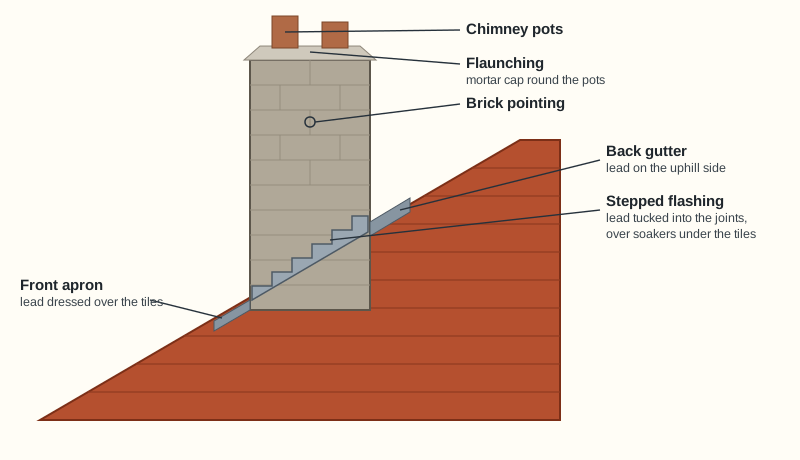
The drawing shows the parts we mean: the flaunching round the pots, the pointing between the bricks, the back gutter on the uphill side, the stepped flashing down each side and the apron across the front. Our guide to chimney leaks and flashing explains the signs of each.
What lead should chimney flashings be made from?
Rolled lead of the right thickness, in short lengths. LABC, drawing on the Lead Sheet Association, gives "a minimum code 4 lead (depending on location)" in lengths of no more than 1.5m. The Lead Sheet Training Academy, as that association has been called since 2018, also says 1.5m lengths, cut down to 1m where lead is bonded to felt, asphalt or single-ply, and warns that "we see the wrong codes of lead used".
Short lengths matter because lead expands and contracts with the sun, and a long piece fixed tight will eventually split. We dress new lead into the brick joints, wedge and point it, and step it down each side so every piece overlaps the one below.
Is a cement fillet as good as lead?
No. Some stacks have a sloping band of mortar where lead flashing should be. Homebuilding & Renovating calls mortar fillets "a cheap, short-life alternative to lead", and once a fillet cracks away from the brick, water runs straight down behind it. Where one has failed we replace it with lead. On a listed house, ask the council before changing the detail, because Historic England says consent is needed for work that affects a listed building's special character.
What is flaunching, and why does it crack?
Flaunching is the sloped mortar collar on top of the stack that holds the pots and sheds rain. It takes the full force of frost and sun, and once it cracks, water gets into the top of the stack. We break out the old collar, re-seat any loose pots and form a new one.
If a flue is no longer used, Homebuilding & Renovating says redundant flues should be capped and ventilated: capped so rain cannot fall straight down, and ventilated so the flue can still dry out. Sealing it completely traps damp in the chimney breast.
Does the brickwork need repointing?
If the joints are worn back or crumbling, yes, because rain soaks into the stack through them. Many of Luton's older chimneys are built of local grey brick: the Bedfordshire and Luton Geology Group says the production of Luton "greys" was a significant industry from the mid-1800s to the 1930s. We rake out the loose mortar and repoint with a mix no harder than the bricks, so the joints rather than the bricks take the weather. A stack that is leaning or badly cracked may need rebuilding above the roofline instead, and we will tell you if it does.
What if the chimney stack is shared with next door?
Then part of it is probably your neighbour's. Homebuilding & Renovating notes that many stacks sit on the party wall, with half belonging to the house next door. For a repair, that means agreeing the work and the scaffold with your neighbour before we start, and settling between you who pays for work that benefits both halves.
Taking a shared chimney down goes further. GOV.UK lists "removing chimneys from a party wall" as work you must tell your neighbour about under the party wall rules.
Can a chimney stack or breast be taken out?
Yes, with the right approvals. Removing a chimney breast and supporting the brickwork above on a steel beam "will require Building Regulations consent", so it goes through building control, and through the party wall process too if the breast is on a shared wall.
Planning is a separate question. On 12 November 2026 none of Luton's Article 4 directions dealt with roofs or chimneys, although the management plan for Plaiters' Lea suggests chimney protection could be considered there in future. If your house is listed or in a conservation area, speak to the council's planning team before a stack comes down.
What does chimney repair cost?
Most chimney jobs are modest, but scaffolding can be a large share of the bill. Checkatrade, updated in April 2026, says "Most chimney repairs cost between £180 and £1,000", with repointing at £300 to £1,000 and flashing at £250 to £1,000. Those are national figures, not ours; we price your stack once we have seen it and know what access it needs, as we do for all chimney and roof work across Luton.
On access, HSE says "sloping roofs require scaffolding to prevent people or materials falling", and on a terrace that can mean edge protection at the back as well as the front. If the scaffold has to stand on the pavement, a council licence is needed; our roof replacement page explains how that works.
Questions people ask us
What code of lead is used for chimney flashings?
LABC, drawing on the Lead Sheet Association, gives a minimum of code 4 depending on location, fitted in lengths of no more than 1.5m.
Do I need to tell my neighbour about work on a shared chimney?
For removing a chimney from a party wall, yes, as GOV.UK lists it as notifiable work. For repairs to a shared stack, agree the work and the scaffold with your neighbour before it starts.
Do I need building regulations approval to remove a chimney breast?
Yes. Taking out the breast and holding up the brickwork above on a steel beam needs Building Regulations consent.
Why does my chimney breast only get damp in heavy rain?
Driving rain gets through failed flashings, cracked flaunching or worn pointing, and many older stacks have no damp-proof course to stop it travelling down. A roof inspection pins down which it is.
Sources and further reading
- Restoring Chimneys, Ian Rock, 4 Jun 2020
- What to do if your chimney leaks, Checkatrade, updated 2 Feb 2022
- How to get it right: Too much abutment flashing?, LABC, 25 Aug 2016
- The top ten dos and don'ts of rolled lead sheet, RIBAJ, updated 4 Nov 2025
- What Permission Might I Need to Make Changes to My Older Home?, Historic England, undated
- Brickmaking (leaflet 1), undated
- Party walls and building work: work you must tell your neighbour about, updated 17 Oct 2024
- Current Article 4 directions, Luton Borough Council
- Plaiters' Lea Conservation Area Management Plan, June 2020
- What is the cost of chimney repair in the UK in 2026?, Checkatrade, updated 04/26
- Roof work (construction safety topics), HSE, 5 Jun 2026
Before you phone
These details help us understand the roof before we see it:
- Where the water shows, and in what weather
- Slate, tile, flat roof or not sure
- Roughly when the house was built
- Any photos, even from the street
- Conservation area or listed, if you know
Chimney repairs and leadwork in the towns around Luton
We carry out chimney repairs in Luton and across the towns below. Each town page explains what is different about the roofs there.
Chimney repairs and leadwork in Dunstable
Chimney repairs and leadwork in Houghton Regis
Chimney repairs and leadwork in Leighton Buzzard
Chimney repairs and leadwork in Ampthill
Chimney repairs and leadwork in Hitchin
Chimney repairs and leadwork in Letchworth Garden City
Chimney repairs and leadwork in Stevenage
Chimney repairs and leadwork in Harpenden
Chimney repairs and leadwork in St Albans
Chimney repairs and leadwork in Welwyn Garden City
Chimney repairs and leadwork in Hemel Hempstead
Chimney repairs and leadwork in Berkhamsted
Chimney repairs and leadwork in Tring
Guides that go with this
What causes a chimney leak, and how is lead flashing repaired?
The usual causes of a chimney leak, what good leadwork looks like, and the party wall and planning points before removing a stack.
Why is my roof leaking in heavy rain?
Where rain gets into a roof, why the stain inside moves, how condensation fools people, and what to do before a roofer arrives.
Roof repair cost in 2026: what do UK price guides say?
National price ranges for repairs, new roofs, gutters, fascias and chimneys, each with its publisher and date, and what pushes a quote up.
Related work
Roof repairs
Slipped slates, cracked tiles, loose ridges and drips through the ceiling, traced to where the water really gets in and put right.
Emergency and storm repairs
After high wind or a downpour, we make the roof safe and weathertight with temporary covers, then photograph everything for your insurer.
Gutters, fascias and soffits
Overflowing gutters, rotten fascia boards and tired soffits renewed with care for loft ventilation, nesting birds, bats and older asbestos boards.
Everything else we do
Flat roofing
Garages, dormers and rear extensions re-covered in EPDM, GRP or built-up felt, laid to proper falls and insulated where the rules require it.
Roof replacement
When patching no longer makes sense, we strip and re-cover the pitched roof with new underlay, battens and fixings, and explain the approvals it needs.
Roof inspections
A look at the roof from outside and the loft, with photographs and a written note of what needs doing now and what can wait.
Tell us about the roof
Give us your name, phone number and postcode, pick the closest match to the problem, and we will ring to discuss it and fix a time to inspect. Or call 01582 377176.