- Home
- Roofing guides
- Leaks in heavy rain
Sources checked 12 November 2026
Why is my roof leaking in heavy rain?
A roof leaking in heavy rain but dry in a shower often points to water being driven past a weak spot, not a hole you can see. This guide helps homeowners and tenants in Luton find where it is getting in, what to do tonight, and what a lasting roof leak repair involves.
Get the roof looked at
Name, number and postcode is enough. We phone back to hear what is happening and set a time to see the roof.
What should I do tonight if the roof is leaking?
Catch the water, keep it away from electrics and stay off the roof. Put a bucket or bowl under the drip with an old towel in it to stop splashing, move furniture and anything electrical out of the way, and if the ceiling is bulging, keep people out of the room beneath it.
If water is running near a light fitting or socket, do not touch it; switch that circuit off at the consumer unit if you can reach it safely. Do not climb a ladder or go on the roof in the dark, rain or wind. The Health and Safety Executive tells roofers themselves not to go on roofs in rain, ice, frost or strong wind, and notes that winds above 23mph affect a person's balance.
Photograph the stain, the drip and any damage before you clear up. The Association of British Insurers advises taking photos or video and keeping receipts, as these form part of any claim.
Where does rain usually get into a roof?
Through a short list of weak points, most of them at joints and edges rather than in the open slope.
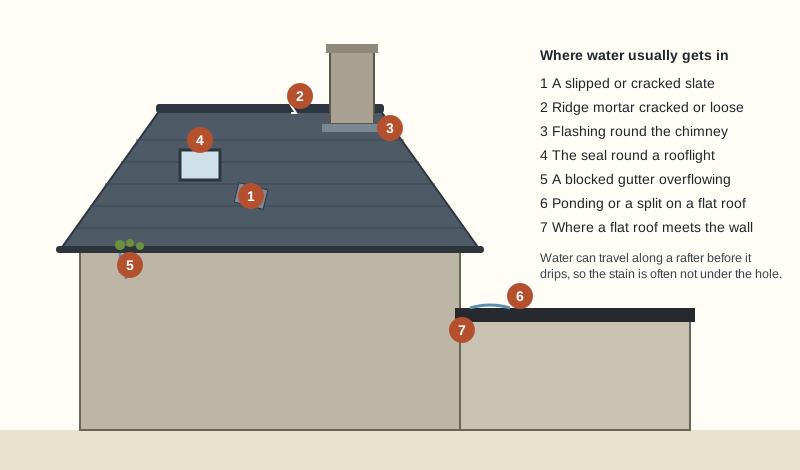
- Slipped or cracked tiles and slates leave a gap that may only let much water in when rain is heavy or blown sideways.
- Ridge and hip mortar cracks with age. Since BS 5534:2014, mortar alone is no longer deemed sufficient to secure ridges, and ridges laid before then were often bedded with nothing else holding them.
- Chimney flashing is the most likely cause of a damp chimney, according to Homebuilding & Renovating.
- Rooflight seals and the flashing kits round them perish and let water track down the frame.
- Blocked gutters overflow behind the fascia or into the wall. Moss on the slope adds to this: Marley says a heavy build-up will inhibit the flow of water off the tiles.
- Flat roofs fail where water ponds; the current standard sets a minimum 1:80 finished fall.
- The joint between a flat roof and the house wall, where the upstand or flashing has cracked or pulled away.
Why does the roof only leak in heavy rain?
Because heavy, wind-driven rain reaches places that light rain never does. A slipped tile, a short flashing or a lifted lap can stay dry in drizzle, then let water in when rain is blown sideways or when gutters and valleys overflow.
It can happen suddenly. After the amber rain warning of 23 September 2024, Luton Borough Council received reports of roof leaks in its own properties. Insurers treat extreme rain separately as well: the ABI counts rainfall of at least 25mm an hour as one of its storm tests, which matters if you go on to claim. Our storm damage and insurance guide explains the rest.
Autumn is when weak points tend to show. At the Met Office's Rothamsted station near Harpenden, October is the wettest month in the 1991 to 2020 averages, with about 78mm, followed closely by November.
Why is the stain nowhere near the leak?
Because water runs before it drips. Once past the tiles, it can follow the underlay, a batten or the top of a rafter for some distance, then drop onto the ceiling wherever it meets a joint, a nail or a low point.
Underlay is meant to sag slightly between rafters; BS 5534 allows a maximum 15mm drape, so water that gets past the tiles runs down it to the gutter. Where the underlay is torn, missing or has perished, that water drops into the loft instead.
So a stain on a bedroom ceiling may come from a flashing several rafters away, or from the chimney rather than the slope. That is why we trace a leak from inside the loft as well as from outside, and photograph the route before suggesting a repair.
Could it be condensation rather than a leak?
Yes, and it is worth ruling out before paying for roof work. Condensation forms when warm, moist air from the house reaches a cold surface in the loft, such as the underlay, the underside of the roof covering or the heads of nails, and turns to droplets.
The clues differ. Condensation tends to show on cold, still nights and frosty mornings, often spread across a wide area, with damp timbers or beads of water on nails. A leak follows rain, often from one wind direction, and leaves a single track you can follow back to one point.
Loft ventilation, insulation pushed into the eaves and moist air from bathrooms all play a part. Damp in general is widespread: the English Housing Survey found 1.4 million homes in England had a damp problem in 2024. A roof inspection that includes the loft tells you which you are dealing with.
Who should I call, and what does a lasting repair involve?
If you own the house, a roofer; if you rent, your landlord first. Luton council tenants can report repairs on 0800 0147 333, and the council's repairs policy lists a leaking roof among the repairs that qualify under the right to repair.
A lasting roof leak repair fixes the cause rather than the stain. That might mean refixing slipped tiles, re-bedding and mechanically fixing a ridge, renewing chimney lead or re-forming a flat roof upstand. A bead of sealant over a crack is a stopgap at best. Where the damage is extensive, a temporary cover keeps the weather out until the permanent work can be done safely; our emergency roof repairs page explains what making safe involves.
To arrange a visit, call 01582 377176 or use the quote form. We handle roof leaks across Luton and the towns around it.
Questions people ask us
Can a roof leak only in heavy rain?
Yes. Wind-driven rain and overflowing gutters reach gaps that stay dry in light rain, such as a slipped tile, a short flashing or cracked ridge mortar.
Is a roof leak covered by home insurance?
Sometimes. The ABI says policies cover sudden and unforeseen damage, not general upkeep, so a leak from storm damage may be covered while one from worn-out flashing may not.
How can I tell condensation from a roof leak?
Condensation tends to appear on cold, dry nights as droplets spread over timbers and nail heads. A leak follows rain, often from one direction, and leaves a single track you can follow back.
Should I go up and look myself?
No. HSE advises against going on roofs in rain, ice, frost or strong wind, and almost one in five deaths in construction work involve roof work. Look from the ground and the loft instead.
Sources and further reading
- Construction: Work at height FAQs, HSE, 11 Mar 2026
- Storms (policy and guidance), ABI, undated
- More stringent roof fixing requirements now in force, 23 Mar 2016
- Restoring Chimneys, Ian Rock, 4 Jun 2020
- How do I remove moss or lichen from my roof?, Marley, updated 11 Sep 2024
- BS 6229:2025 update: key points for members, NFRC, 18 Dec 2025
- Flooding update after heavy rainfall in Luton, 23–24 Sep 2024
- Rothamsted location-specific long-term averages 1991–2020, Met Office
- What changes have there been to BS 5534 since the revision in 2014?, Marley, undated
- EHS 2024 to 2025 headline findings on housing quality and energy efficiency: Introduction and key findings, 29 Jan 2026
- Repairs and servicing your council home
- Repairs Policy v1.0, adopted 6 Oct 2025, updated Nov 2025
- Roof work (construction safety topics), HSE, 5 Jun 2026
Before you phone
These details help us understand the roof before we see it:
- Where the water shows, and in what weather
- Slate, tile, flat roof or not sure
- Roughly when the house was built
- Any photos, even from the street
- Conservation area or listed, if you know
Written by Luton Roofworks, roofers in Luton covering south Bedfordshire and west Hertfordshire. If your roof needs looking at, use the form or call 01582 377176.
Related roofing work
Roof repairs
Slipped slates, cracked tiles, loose ridges and drips through the ceiling, traced to where the water really gets in and put right.
Emergency and storm repairs
After high wind or a downpour, we make the roof safe and weathertight with temporary covers, then photograph everything for your insurer.
Roof inspections
A look at the roof from outside and the loft, with photographs and a written note of what needs doing now and what can wait.
More roofing guides
Roof repair cost in 2026: what do UK price guides say?
National price ranges for repairs, new roofs, gutters, fascias and chimneys, each with its publisher and date, and what pushes a quote up.
EPDM, GRP or felt: which flat roof should you choose?
How EPDM, GRP and felt flat roofs compare on certified lifespan, drainage falls, insulation rules and fire ratings near a boundary.
What causes slipped roof tiles, and how should ridges be fixed?
Why tiles and slates slip, what the British Standard now says about fixings, and how mortar and dry ridge systems compare.
What causes a chimney leak, and how is lead flashing repaired?
The usual causes of a chimney leak, what good leadwork looks like, and the party wall and planning points before removing a stack.
Do I need planning permission or building regulations for a new roof?
When a new roof needs building regulations approval, planning permission or listed building consent, and the extra estate consents in Letchworth and Welwyn Garden City.
Storm damage to your roof: what will insurance cover?
What insurers count as a storm, the evidence they want, how to make a roof safe without risking a claim, and storm-chasing traders.
Roof moss removal: is it needed, and how should it be done?
Whether moss actually harms tiles, what it does to gutters, why jet washing is advised against and how roof coatings can affect guarantees.
Tell us about the roof
Give us your name, phone number and postcode, pick the closest match to the problem, and we will ring to discuss it and fix a time to inspect. Or call 01582 377176.